KDFlow
A user-friendly and efficient framework for LLM knowledge distillation.
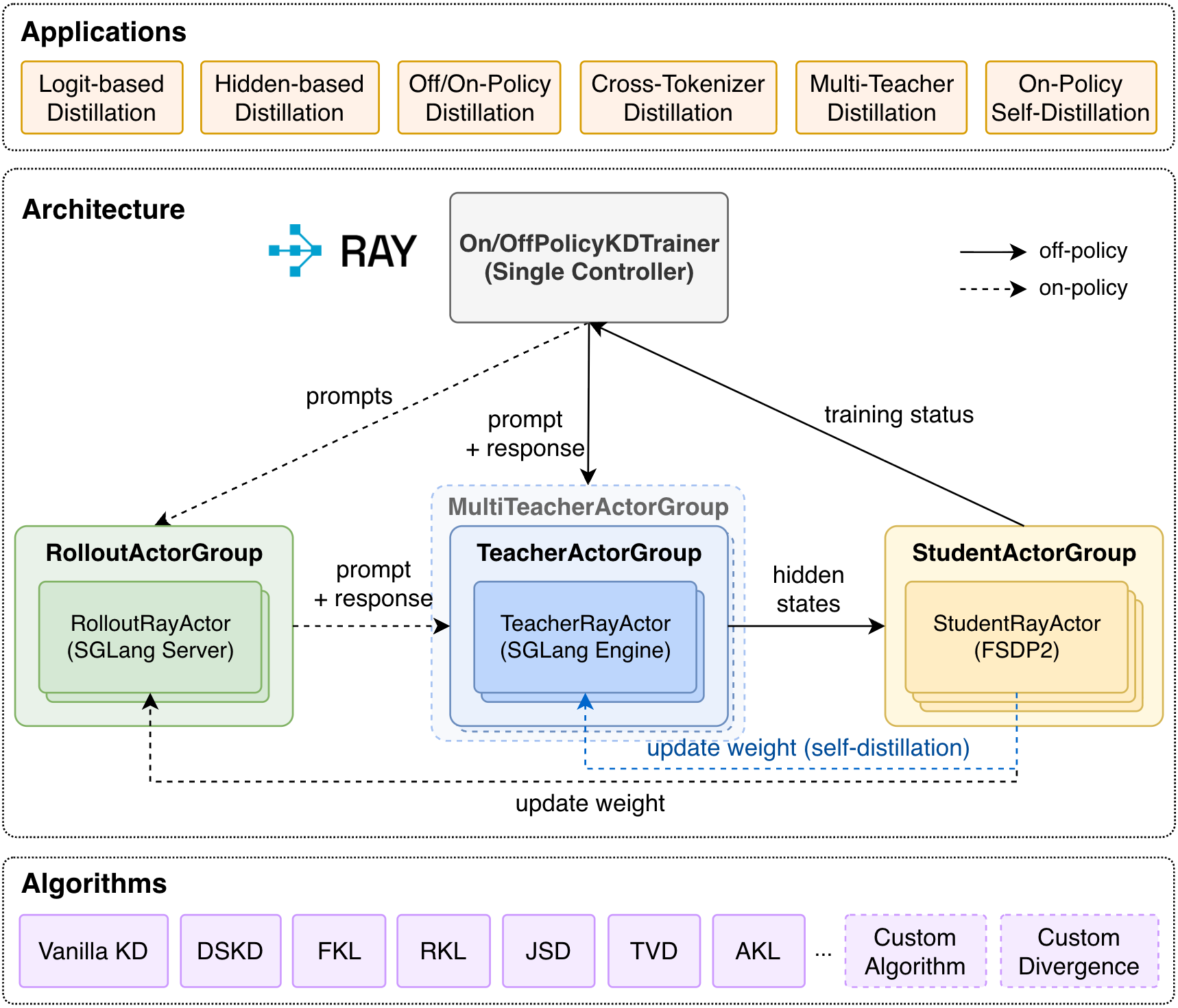
KDFlow is a scalable knowledge-distillation (KD) framework for large language models. It decouples the teacher and student backends — running the teacher on SGLang for high-throughput inference, and the student on FSDP2 for memory-efficient training — and colocate them on the same GPUs through a sleep / wakeup mechanism. The result is a fast, flexible KD pipeline that scales from a single 8-GPU node to multi-node TP/PP setups for 200B+ teachers.
Why KDFlow?
- Decoupled infrastructure — SGLang for teacher inference, FSDP2 for student training.
- Off-policy KD — distill from pre-collected teacher hidden states on static datasets.
- On-policy KD — student rollouts feed the teacher in a closed loop.
- Cross-tokenizer KD — distill across different tokenizers (e.g. Llama → Qwen).
- Multi-teacher KD — route samples to domain-specific teachers with
--multi_teacher_configand--teacher_routing_key. - SFT (black-box KD) — single-controller supervised fine-tuning on collected data.
- Multimodal support — distill vision-language models such as Qwen3-VL.
- GPU co-location — teacher and student share GPUs via the sleep/wakeup mechanism.
- Hidden-state transfer — only teacher hidden states (not full logits) cross the process boundary, via shared memory.
- Pluggable algorithms / losses — built-in
vanilla_kd,simple_ctkd,dskd,sftplus 9 registered loss functions; new ones can be added with a single decorator. - LoRA + Liger Kernel + dynamic batching for efficient student training.
- W&B integration out of the box.
- 1.4× – 6× faster than mainstream KD frameworks.
Where to go next
Get up and running
Install KDFlow and run your first distillation job in minutes.
User guide
Walk through every supported training scenario with annotated example scripts.
- Off-Policy KD
- On-Policy KD
- Multi-Teacher KD
- Cross-Tokenizer KD
- Supervised Fine-Tuning
- Multimodal (VLM) Distillation
- Evaluation
Concepts
Understand the architecture, supported KD algorithms, and loss functions.
Reference
Full CLI surface, argument tables, and extension hooks.
Citation
If KDFlow helps your research, please cite:
@article{zhang2026kdflow,
  title={KDFlow: A User-Friendly and Efficient Knowledge Distillation Framework for Large Language Models},
  author={Zhang, Songming and Zhang, Xue and Zhang, Tong and Hu, Bojie and Chen, Yufeng and Xu, Jinan},
  journal={arXiv preprint arXiv:2603.01875},
  year={2026}
}
KDFlow is released under the MIT License.